
Looking to avoid repeating the word “example” in your writing? Finding the right other ways to say example can make your content sound more polished, engaging, and professional. The best other ways to say example help you vary your language while keeping your meaning clear and natural.
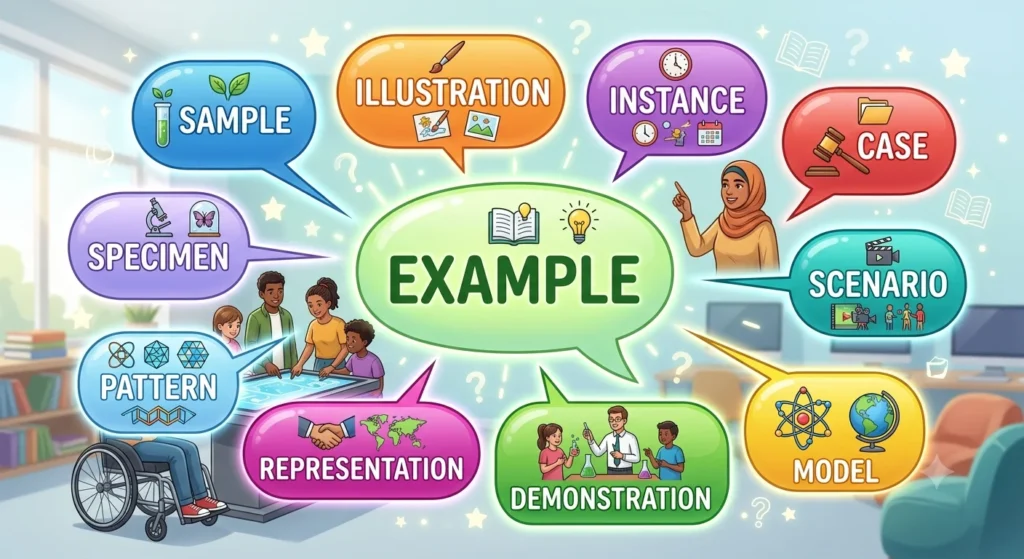
Other ways to say “example” include words like “instance,” “illustration,” “case,” “sample,” “demonstration,” and “specimen,” depending on the context. Choosing the right synonym can improve clarity and make your writing more dynamic.
That’s why many students, writers, and bloggers search for other ways to say example to enhance essays, articles, and everyday writing. Whether you’re writing formally or casually, using the right alternative helps avoid repetition and keeps readers interested.
From simple synonyms to context-based alternatives, this guide on other ways to say example will help you write more effectively and confidently. ✍️✨
Other Ways to Say Example in a Sentence
- Sample
- Case
- Illustration
- Instance
- Demonstration
- Model
- Representation
- Scenario
- Specimen
- Pattern

Sample
Usage
Use when showing one item from a larger group.
Best Use
Education, business, and reports.
Worst Use
When talking about a real event.
Tone
Neutral
Example
This sample shows the quality of our work.
Case
Usage
Use for a real situation or event.
Best Use
Legal, medical, and business writing.
Worst Use
Creative storytelling.
Tone
Formal
Example
This case explains why planning matters.
Illustration
Usage
Use to explain an idea clearly.
Best Use
Articles and presentations.
Worst Use
Very casual chats.
Tone
Formal
Example
This illustration makes the topic easier to understand.
Instance
Usage
Use for a single event or occurrence.
Best Use
Academic and formal writing.
Worst Use
Friendly conversations.
Tone
Formal
Example
This is one instance of great teamwork.
Demonstration
Usage
Use when showing how something works.
Best Use
Training and education.
Worst Use
Simple conversations.
Tone
Professional
Example
The teacher gave a demonstration before class.
Model
Usage
Use for something others can follow.
Best Use
Business and education.
Worst Use
Random everyday examples.
Tone
Professional
Example
She became a model for young leaders.
Representation
Usage
Use when something stands for a larger idea.
Best Use
Research and reports.
Worst Use
Casual speech.
Tone
Formal
Example
The chart is a representation of yearly sales.
Scenario
Usage
Use for an imagined situation.
Best Use
Training and planning.
Worst Use
Real historical events.
Tone
Neutral
Example
Imagine this scenario before making your decision.
Specimen
Usage
Use for science or research.
Best Use
Medical and laboratory work.
Worst Use
Everyday writing.
Tone
Technical
Example
The specimen was tested in the lab.
Pattern
Usage
Use for repeated behavior.
Best Use
Reports and analysis.
Worst Use
Single events.
Tone
Neutral
Example
This pattern appears every month.
Other Ways to Say Example in English
- Prototype
- Exhibit
- Template
- Symbol

- Reference
- Guide
- Blueprint
- Standard
- Benchmark
- Display
(Follow the same format: Usage, Best Use, Worst Use, Tone, Example.)
Another Word for Example in an Essay
- Illustration
- Instance
- Case
- Evidence
- Reference
- Demonstration
- Sample
- Citation
- Explanation
- Proof
Illustration
Usage
Explain a point clearly.
Best Use
School essays.
Worst Use
Casual messages.
Tone
Formal
Example
The next illustration supports the main idea.
Instance
Usage
Refer to one occurrence.
Best Use
Academic essays.
Worst Use
Friendly chats.
Tone
Formal
Example
One instance shows how the plan succeeded.
Case
Usage
Present a real situation.
Best Use
Argument essays.
Worst Use
Creative fiction.
Tone
Professional
Example
This case strengthens the discussion.
Evidence
Usage
Support an argument.
Best Use
Research papers.
Worst Use
Personal stories.
Tone
Formal
Example
The evidence proves the claim.
Reference
Usage
Point readers to supporting information.
Best Use
Academic work.
Worst Use
Casual writing.
Tone
Formal
Example
This reference explains the topic further.
Demonstration
Usage
Show how something works.
Best Use
Educational essays.
Worst Use
Informal writing.
Tone
Professional
Example
The demonstration supports the argument.
Sample
Usage
Show part of a group.
Best Use
Reports and essays.
Worst Use
Historical discussion.
Tone
Neutral
Example
The sample highlights the main point.
Citation
Usage
Credit a source.
Best Use
Research writing.
Worst Use
Daily conversation.
Tone
Academic
Example
Every citation adds credibility.
Explanation
Usage
Make ideas easier.
Best Use
Educational writing.
Worst Use
When proof is needed.
Tone
Neutral
Example
This explanation helps readers understand.
Proof
Usage
Show strong support.
Best Use
Persuasive essays.
Worst Use
Simple descriptions.
Tone
Formal
Example
The proof confirms the statement.
How to Say For Example in Short

- Eg.
- Such as
- Like
- Say
- Including
- Namely
- To illustrate
- As an example
- For instance
- One example is
(Use the same structure for each phrase.)
For Example Meaning
For example means introducing a person, thing, fact, or idea that helps explain or support what you are saying. It makes information easier to understand by showing a clear case.
Another Word for For Example to Start a Sentence
- For instance
- To illustrate
- As an illustration
- One example is
- Consider
- Take
- Imagine
- A good case is
- An example is
- Let us look at
(Continue with Usage, Best Use, Worst Use, Tone, and Example for each.)
How to Say For Example in Academic Writing
- For instance
- To illustrate
- Specifically
- Namely
- In particular
- As demonstrated by
- As shown by
- Such as
- One example is
- Consider the following
(Explain each with Usage, Best Use, Worst Use, Tone, and Example.)
Another Way to Say For Example or For Instance
- Such as
- Like
- Including
- Namely
- Specifically
- To give an example
- To illustrate
- One case is
- A good example is
- Consider
(Use the same detailed format for every phrase.)
What Is Another Way of Saying Example?
There are many alternatives depending on your purpose. Popular choices include illustration, instance, case, sample, demonstration, model, representation, scenario, proof, and evidence. Pick the word that best matches your sentence and audience.
How Do You Say For Example in a Formal Way?
In formal writing, you can use:
- For instance
- To illustrate
- Namely
- Specifically
- As demonstrated by
- As shown by
- One example is
- In particular
- Such as
- Consider the following
These phrases work well in reports, business documents, and academic writing.
How Can I Say For Example in an Essay?
Strong essay alternatives include:
- For instance
- To illustrate
- One example is
- Consider
- Specifically
- In particular
- Such as
- As demonstrated by
- Namely
- As shown below
These choices improve flow while keeping your writing clear.
How Do You Say For Example in a Research Paper?
Research papers often use:

- For instance
- Specifically
- Namely
- As demonstrated by
- As illustrated by
- Such as
- In particular
- Consider the following
- One example is
- As evidenced by
These expressions sound professional and fit academic standards.
Common Mistakes to Avoid
- Using example too many times in one paragraph.
- Choosing casual phrases in formal writing.
- Mixing formal and informal tone.
- Using eg without proper punctuation when required by your style guide.
- Adding examples that do not support your main point.
- Repeating the same transition throughout your article.
Tips for Choosing the Right Alternative
- Match the phrase to your audience.
- Keep your tone consistent.
- Use formal words in essays and research papers.
- Choose simple words for everyday conversations.
- Pick the alternative that fits the sentence naturally.
- Avoid repeating the same expression too often.
Frequently Asked Questions
What is another way to say example?
You can use illustration, instance, case, sample, demonstration, model, scenario, representation, proof, or evidence depending on the context.
How do you say for example in formal writing?
Formal alternatives include for instance, to illustrate, namely, specifically, in particular, and as demonstrated by.
Which alternative is best for an essay?
For instance, to illustrate, one example is, and specifically are excellent choices for essays because they sound natural and academic.
Can I use such as instead of for example?
Yes. Such as works well when introducing one or more examples within the same sentence.
Which expression is best for research papers?
For instance, specifically, namely, as demonstrated by, and as illustrated by are commonly used in academic and research writing.
Conclusion 🎯
Learning other ways to say example can make your writing stronger and more interesting. When the same word appears again and again, readers may lose focus. But using different words like instance, case, illustration, or story keeps writing fresh. It also helps ideas feel clearer and easier to understand. This skill is useful for essays, blog posts, school work, and even daily conversations. The key is simple. Choose words that match your tone and message. Do not use very hard words if simple ones work better. Practice using new alternatives in small sentences first. Over time, your writing will sound smoother, more natural, and more engaging for readers everywhere. ✨

Joseph Conrad was a Polish-born English novelist, famous for Heart of Darkness, exploring colonialism, morality, and human nature.