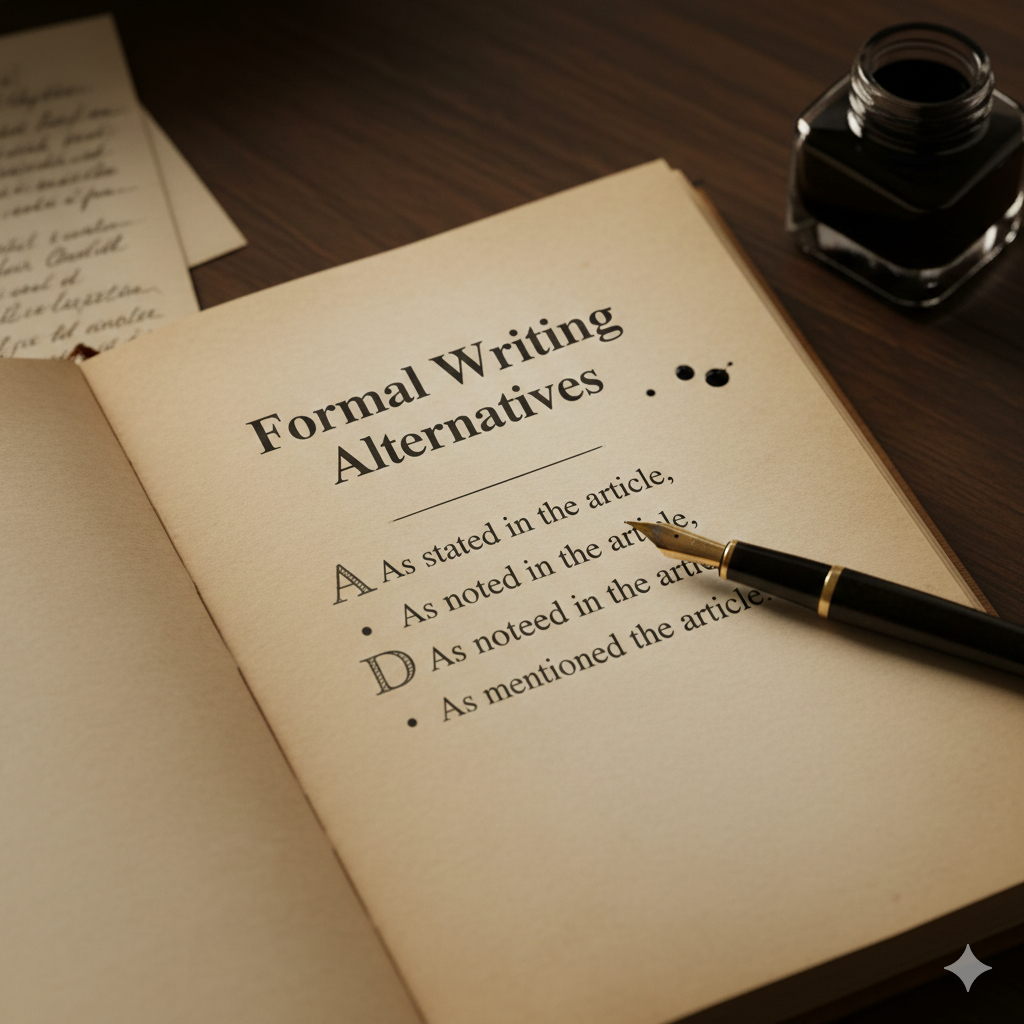
Looking for better other ways to say “according to the article” in your writing?
Using the same phrase repeatedly can make your content sound repetitive, so choosing varied expressions helps improve clarity and flow.
Popular alternatives include:
- “as stated in the article”
- “as mentioned in the article”
- “as noted in the article”
- “based on the article”
- “as explained in the article”
- “as discussed in the article”
- “as highlighted in the article”
These phrases are useful for:
- Essays and assignments
- Reports and summaries
- General writing
Using different expressions makes your writing more natural, polished, and easier to read.
This guide shares simple and effective alternatives to “according to the article” that you can use confidently in any type of writing.
Alternatives for Academic Writing
When you write essays or research papers, you need language that sounds professional and precise. These options work well in formal academic settings.
As stated by
- Example: As stated by the researchers, regular exercise improves memory function in older adults.
- Best use: When you want to sound authoritative and formal
- Worst use: In casual conversations or informal emails
- Tone: Formal and respectful
- Usage tip: This phrase works perfectly when citing well-known experts or established research institutions.
Based on the findings of
- Example: Based on the findings of the study, students learn better in small groups with hands-on activities.
- Best use: When discussing specific research results
- Worst use: When you only have one or two sources
- Tone: Authoritative and evidence-driven
- Usage tip: Use this when you want to emphasize that your conclusion comes directly from research data.
In the words of
- Example: In the words of the author, creativity cannot be forced and must flow naturally.
- Best use: When quoting someone directly or nearly directly
- Worst use: When paraphrasing general ideas
- Tone: Literary and respectful
- Usage tip: This phrase adds a touch of elegance to your writing. It works wonderfully when the original wording is memorable.
As demonstrated by

- Example: As demonstrated by the experiment, plants grow faster with classical music playing nearby.
- Best use: When providing clear proof or evidence
- Worst use: When the evidence is weak or unclear
- Tone: Scientific and confident
- Usage tip: This is your go-to phrase when you have visual or measurable proof.
Per the research of
- Example: Per the research of Johnson and Lee, sleep quality directly affects work performance.
- Best use: In business or scientific reports
- Worst use: In creative writing or personal stories
- Tone: Professional and slightly formal
- Usage tip: This phrase is commonly used in business settings. It sounds professional without being overly academic.
From the perspective of
- Example: From the perspective of the historian, the event changed the course of modern politics.
- Best use: When presenting someone’s viewpoint or interpretation
- Worst use: When stating universal facts
- Tone: Analytical and thoughtful
- Usage tip: Use this when you want to acknowledge that different people see things differently.
As reported by
- Example: As reported by the committee, the project will finish on time and within budget.
- Best use: When sharing news or official statements
- Worst use: When the source is unreliable
- Tone: Journalistic and factual
- Usage tip: This phrase works great in news writing or when sharing official announcements.
Consistent with the work of
- Example: Consistent with the work of previous scholars, this study supports the attachment theory.
- Best use: When showing how research builds on earlier work
- Worst use: When the connection is weak
- Tone: Scholarly and comparative
- Usage tip: Use this to show academic continuity. It demonstrates that you understand how research builds over time.
Casual and Everyday Options
For emails, blogs, and daily conversations, these more relaxed alternatives work wonderfully. They help you sound natural and approachable while still giving credit to your sources.
As mentioned in
- Example: As mentioned in the newsletter, the community event starts at noon on Saturday.
- Best use: When referring to something your audience has already seen
- Worst use: When the source is unfamiliar to your readers
- Tone: Friendly and helpful
- Usage tip: This phrase works well in follow-up communications. It reminds people of information they should already know.
Going by what
- Example: Going by what the article says, we should try this new time management method.
- Best use: In conversations and informal writing
- Worst use: In academic papers or official documents
- Tone: Casual and approachable
- Usage tip: Use this in emails to colleagues or friends. It sounds conversational and natural.
If you look at
- Example: If you look at the study results, the answer becomes immediately clear.
- Best use: When guiding readers to notice something
- Worst use: When citing multiple complex sources
- Tone: Conversational and instructional
- Usage tip: This phrase invites readers to see things from your perspective. It is engaging and participatory.
From what I read in
- Example: From what I read in the report, sales figures are up this quarter.
- Best use: When sharing your personal reading experience
- Worst use: When you need to sound like an expert
- Tone: Personal and trustworthy
- Usage tip: This is honest and humble. It shows you are sharing your understanding rather than claiming absolute authority.
The article tells us
- Example: The article tells us that exercise helps with stress management and overall well-being.
- Best use: In presentations or group discussions
- Worst use: In formal research papers
- Tone: Direct and clear
- Usage tip: This phrasing is direct and easy to understand. It works well when explaining things to a general audience.
To quote the source
- Example: To quote the source, the situation remains uncertain and requires further investigation.
- Best use: When including a direct quote
- Worst use: When paraphrasing loosely
- Tone: Respectful and neutral
- Usage tip: Use this when you want to be precise about exact wording. It shows you respect the original text.
In the writer’s view
- Example: In the writer’s view, the new policy will help small businesses thrive.
- Best use: When highlighting an opinion rather than a fact
- Worst use: When citing scientific research
- Tone: Subjective and thoughtful
- Usage tip: This phrase clearly signals that you are sharing an opinion. It prevents readers from confusing facts with perspectives.
That article makes it clear
- Example: That article makes it clear that teamwork improves overall project results.
- Best use: When the source is very persuasive
- Worst use: When the source is ambiguous
- Tone: Confident and engaging
- Usage tip: Use this when the source is particularly convincing. It shows you are confident in what the article says.
As far as the article goes
- Example: As far as the article goes, the situation looks promising for investors.
- Best use: In casual discussions
- Worst use: In formal writing
- Tone: Informal and conversational
- Usage tip: This is very casual. Use it only with people you know well or in informal settings.
Showing Agreement or Support
These phrases work well when you want to emphasize that the source supports your point. They strengthen your argument by showing alignment with credible sources.
Supporting what
- Example: Supporting what the research found, our own experience matches these results perfectly.
- Best use: When your personal experience agrees with the source
- Worst use: When you have no evidence of your own
- Tone: Confident and collaborative
- Usage tip: This phrase shows you are not just citing sources but have real-world experience that backs them up.

In agreement with
- Example: In agreement with the author, I believe reading improves empathy and understanding.
- Best use: When showing alignment with the source
- Worst use: When you only partially agree
- Tone: Respectful and unified
- Usage tip: Use this to show intellectual solidarity. It suggests you and the source are on the same page.
Corroborating the claims of
- Example: Corroborating the claims of the study, we observed similar patterns in our own research.
- Best use: In research when your findings match another study
- Worst use: In everyday conversation
- Tone: Scientific and precise
- Usage tip: This is a powerful word for academic writing. It shows independent verification of findings.
The source confirms that
- Example: The source confirms that customer satisfaction has increased by twenty percent.
- Best use: When stating verified facts
- Worst use: When the source is not authoritative
- Tone: Factual and reassuring
- Usage tip: Use this when you want to provide certainty. It reassures readers that the information is reliable.
Backing up the idea that
- Example: Backing up the idea that coffee boosts productivity, the article presents compelling data.
- Best use: In persuasive writing
- Worst use: In very formal academic writing
- Tone: Energetic and persuasive
- Usage tip: This phrase adds energy to your writing. It sounds active and convincing.
Lending support to
- Example: Lending support to the theory, the research shows clear and consistent patterns.
- Best use: When building an argument
- Worst use: When the evidence is weak
- Tone: Academic and supportive
- Usage tip: This is elegant and academic. It shows you are adding weight to an existing idea.
Taking a cue from
- Example: Taking a cue from the article, I decided to change my morning routine completely.
- Best use: When the source inspires action
- Worst use: When citing technical research
- Tone: Personal and practical
- Usage tip: This phrase is personal and actionable. It shows the source influenced your behavior.
Following what
- Example: Following what the expert suggests, we organized the files in a more logical way.
- Best use: When taking action based on advice
- Worst use: When the advice is questionable
- Tone: Action-oriented
- Usage tip: Use this when you are implementing advice. It shows practical application of knowledge.
As the author puts it
- Example: As the author puts it, kindness is a superpower that changes everything.
- Best use: When the phrasing is memorable
- Worst use: When the wording is unclear
- Tone: Direct and quotable
- Usage tip: This phrase sets up a quote nicely. It prepares readers for the author’s exact words.
This aligns with
- Example: This aligns with what the research tells us about different learning styles.
- Best use: When showing consistency between sources
- Worst use: When the connection is forced
- Tone: Logical and clear
- Usage tip: Use this to show coherence in your argument. It demonstrates that your ideas fit together logically.
90+ Other Ways to Say In the Article ⚡ Small Change Big Impact
Presenting Alternative Views
Sometimes you need to show that you are considering different perspectives. These phrases handle that gracefully and professionally.
On the other hand
- Example: On the other hand, the article presents a completely different conclusion.
- Best use: When showing contrasting views
- Worst use: When you only have one source
- Tone: Balanced and fair
- Usage tip: This is a classic transition. It prepares readers for an opposing viewpoint.
Counter to what
- Example: Counter to what the study claims, real-world results differ significantly.
- Best use: When the evidence contradicts the source
- Worst use: When you want to sound agreeable
- Tone: Critical but respectful
- Usage tip: Use this when you have strong evidence against a source. It shows intellectual courage.
Despite what
- Example: Despite what the article suggests, many experts in the field disagree.
- Best use: When challenging a source
- Worst use: When you have no strong evidence
- Tone: Defiant but reasoned
- Usage tip: This shows you are willing to challenge authority. It works best when you have good reasons.
In contrast to
- Example: In contrast to the researcher’s view, teachers see different patterns in classrooms.
- Best use: When comparing conflicting viewpoints
- Worst use: When the difference is minimal
- Tone: Objective and comparative
- Usage tip: Use this to highlight differences clearly. It helps readers see both sides.
Going against what
- Example: Going against what the report says, our data tells another story entirely.
- Best use: When your experience contradicts the source
- Worst use: When you lack strong evidence
- Tone: Confident and challenging
- Usage tip: This phrase is bold and confident. It shows you trust your own data.
Contrary to the claim that
- Example: Contrary to the claim that technology isolates people, the article shows it connects them.
- Best use: In argumentative writing
- Worst use: In diplomatic communication
- Tone: Argumentative but fair
- Usage tip: Use this in debates or persuasive essays. It clearly sets up your counterargument.
The article argues for
- Example: The article argues for longer school days and more structured activities.
- Best use: When presenting the article’s main position
- Worst use: When the article is neutral
- Tone: Persuasive and clear
- Usage tip: This phrase identifies the article’s main argument. It helps readers understand what the source advocates.
Meanwhile, another source states
- Example: Meanwhile, another source states the opposite position with equal conviction.
- Best use: When comparing multiple sources
- Worst use: When you only have one source
- Tone: Comparative and balanced
- Usage tip: Use this when synthesizing multiple sources. It shows you have done thorough research.
Taking issue with
- Example: Taking issue with the findings, the critique raises several valid points.
- Best use: When challenging a source’s conclusions
- Worst use: When you agree with the source
- Tone: Critical and analytical
- Usage tip: This phrase is respectful yet critical. It shows you are thinking carefully.
Questioning the assumption that
- Example: Questioning the assumption that money equals happiness, the article explores other factors.
- Best use: When examining underlying beliefs
- Worst use: When the assumption is well-proven
- Tone: Thoughtful and challenging
- Usage tip: Use this to dig deeper. It shows you are not accepting things at face value.
Strengthening Your Argument
These phrases help you build a stronger case using your source material. They add conviction and clarity to your writing.
This proves that

- Example: This proves that regular practice significantly improves musical skills.
- Best use: When the evidence is conclusive
- Worst use: When the evidence is suggestive only
- Tone: Confident and conclusive
- Usage tip: Use this only when you are absolutely certain. Overusing it can make you seem overconfident.
The evidence suggests
- Example: The evidence suggests that the new policy has been effective so far.
- Best use: When there is supporting data
- Worst use: When the evidence is weak
- Tone: Cautious and measured
- Usage tip: This is the cautious researcher’s favorite phrase. It shows intellectual honesty.
Given the findings of
- Example: Given the findings of the research, we need to reconsider our approach.
- Best use: When the findings are significant
- Worst use: When the findings are trivial
- Tone: Serious and thoughtful
- Usage tip: Use this when research demands action. It shows you take findings seriously.
As shown through
- Example: As shown through the experiment, the treatment was effective in most cases.
- Best use: When presenting clear results
- Worst use: When the results are unclear
- Tone: Scientific and factual
- Usage tip: This is straightforward and evidence-based. It works well in research papers.
It follows from
- Example: It follows from the article that more funding is needed for research.
- Best use: When making logical deductions
- Worst use: When the logic is flawed
- Tone: Logical and clear
- Usage tip: Use this to show logical reasoning. It demonstrates critical thinking.
If the article is correct
- Example: If the article is correct, we should see positive results within six months.
- Best use: When the article is trustworthy
- Worst use: When you have doubts
- Tone: Conditional and thoughtful
- Usage tip: This shows healthy skepticism. It acknowledges that sources can be wrong.
Seeing that
- Example: Seeing that the report recommends this approach, we will implement it.
- Best use: When taking action based on recommendations
- Worst use: When the recommendation is unclear
- Tone: Action-oriented
- Usage tip: Use this to show you are responsive to good advice. It sounds proactive.
The article makes a strong case for
- Example: The article makes a strong case for renewable energy adoption.
- Best use: When the article is convincing
- Worst use: When the argument is weak
- Tone: Persuasive and confident
- Usage tip: Use this when you agree with the article’s main point. It shows endorsement.
90+ Other Ways to Say Says in Writing ✍️ Tiny Detail You Miss
Frequently Asked Questions
What is another way of saying according to the article?
You can say as stated in the article, based on the article, or the article mentions. Each option works well depending on your context and audience.
What should I say instead of according to in academic writing?
Use phrases like as demonstrated by, based on the findings of, or consistent with the work of. These sound more professional and precise.
What can I say instead of in the article?
Try throughout the work, as mentioned in the text, or the source suggests. These variations add variety to your writing.
What is a better word for according to for casual writing?
Going by what, as far as the article goes, or the article tells us work beautifully in informal situations.
How can I avoid repeating according to too often?
Rotate through different phrases. Read your writing aloud to hear where you need variety. A thesaurus can help you find fresh options.
When should I use according to instead of alternatives?
Use according to when it feels natural and fits the tone. There is nothing wrong with using it sometimes. Just do not overuse it.
Can I use these alternatives in spoken English?
Absolutely. Many of these phrases work perfectly in presentations, meetings, and conversations. They make you sound more articulate.
Conclusion
Using alternatives to according to the article helps your writing sound smoother and more confident. Repeating the same phrase can distract readers and weaken your message. By choosing simple and clear replacements, you guide readers naturally through your ideas.
Different situations call for different tones, so formal writing may need structured phrases, while blogs work best with conversational options. Short alternatives also keep sentences clean and easy to read. The key is clarity. When readers understand your point without effort, your writing becomes stronger. Practice using these variations, and soon your content will feel more polished, natural, and enjoyable for any audience.

Arundhati Roy is an Indian author and activist, best known for The God of Small Things, blending powerful storytelling with social and political themes.